Diabesity Research: Experimental Implant Lowers Blood Sugar and Weight in Mice
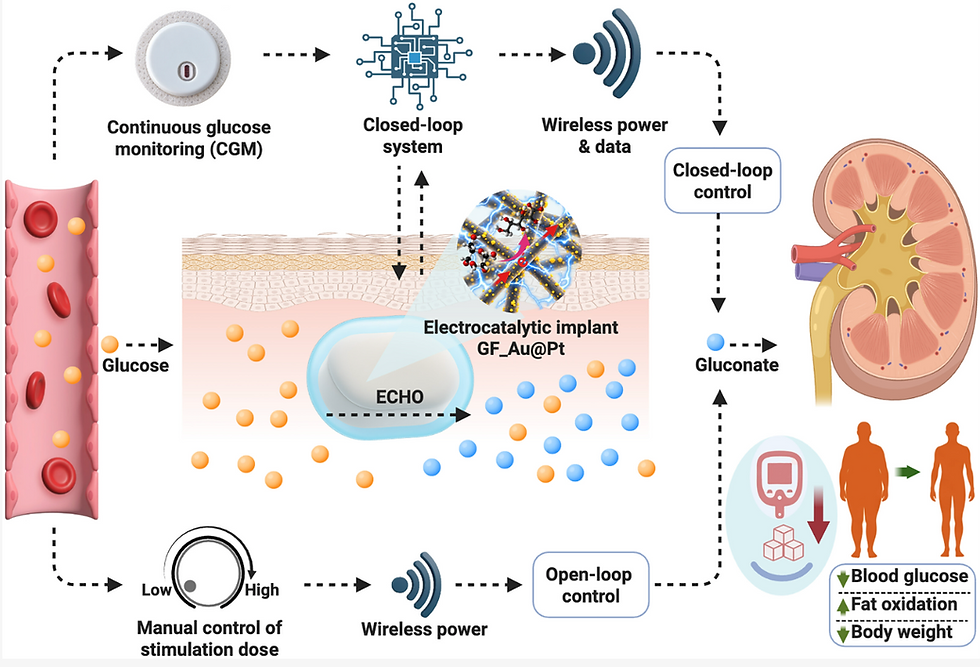
The ECHO system combines continuous glucose monitoring with a wirelessly powered electrocatalytic implant that oxidizes excess glucose to gluconate for renal clearance. In mice with diabesity, autonomous closed-loop control restored glucose homeostasis, reduced body weight, and promoted fat utilization without glucose-lowering drugs. [Figure created with BioRender.com. Maity, D. (2026) https://BioRender.com/r5kl19g]
An experimental implant may point to a new way to manage diabesity, the combination of type 2 diabetes and obesity. In a study published in Science, researchers used a wirelessly powered device to lower blood glucose and reduce body weight in mice.
The technology uses electricity to change the glucose itself. A catalyst made with gold, platinum and graphite converts glucose into gluconate, a substance the body can eliminate through urine. This process removes some glucose from the supply available for energy use or storage.
The implant works with a continuous glucose monitor and a smartphone. When glucose rises above a set threshold, the system activates the chemical reaction. When levels return to the desired range, it switches off. This automatic feedback is designed to respond to changing glucose levels while limiting the risk of blood sugar falling too low.
Called ECHO, short for electrocatalytic closed-loop health optimization, the device produced several encouraging results. The researchers reported that low-power activation restored glucose balance within an hour in mice with type 2 diabetes. Treatment also shifted metabolism toward using fat for fuel and reduced triglycerides, a type of fat in the blood.
Over six weeks, the researchers detected no hypoglycemia, or abnormally low blood sugar, and reported no detectable adverse physiological, inflammatory or behavioral effects. Those observations provide an initial safety signal, but six weeks of testing in mice cannot establish long-term safety in humans.
The researchers also tested the system in five liters of a glucose-containing solution, roughly the volume of blood in an adult. It successfully converted glucose in that setting. However, a laboratory solution cannot reproduce the complexity of a living person, and the technology has not yet been tested in humans.
For people living with diabesity, the research introduces a possible future approach to managing blood sugar. Its practical value will depend on further evidence: whether the implant can work reliably in people, remain effective over time and offer benefits that justify the risks of implantation. The current findings establish a reason for further research, rather than a treatment ready for everyday care.
SOURCES
[1] Original study: Maity, D., Guha Ray, P., Buchmann, P., Charpin-El Hamri, G., and Fussenegger, M. (2026). "Wireless electrocatalytic closed-loop system for drug-free management of diabesity." Science, 394(6822), eady8560. Published October 22, 2026. DOI: 10.1126/science.ady8560.https://www.science.org/doi/10.1126/science.ady8560Study abstract: https://pubmed.ncbi.nlm.nih.gov/42912137/
[2] Supporting explanation: ETH Zurich. "Tackling diabetes with an electronic implant: how a tiny catalyst lowers blood sugar." October 22, 2026.https://bsse.ethz.ch/news-and-events/d-bsse-news/2026/10/tackling-diabetes-with-an-electronic-implant-how-a-tiny-catalyst-lowers-blood-sugar.html



Comments